For Oxford Nanopore plasmid sequencing

Validated plasmid sequences from your nanopore reads, in minutes.

Upload a basecalled run. PlasValidate assembles every plasmid, checks each base against the reads and gives you the sequence with a clear PASS, WARN or FAIL, and the reason. No reference, expected size or account needed. Without a design, a PASS means the reads support the sequence, not that it is your design.

Free for research use · No account needed · Your reads are deleted 24 hours after your run finishes · or run the example in one click

More samples exactly right
372 / 376
PlasValidate 372
EPI2ME 348

samples reproduced base for base on Oxford Nanopore's public plasmid benchmark, from the reads alone. EPI2ME, given each clone's expected size: 348 (345 in Oxford Nanopore's own published results). The 4 misses are one clone, on four flow cells, that is a mixture in which the design is the minority version.

About 16× faster
21 min
PlasValidate 21 min
EPI2ME 5.6 h

wall-clock for all 384 samples, four flow cells, on one workstation with 12 CPU threads and nothing else running, with a fifth of EPI2ME's CPU time. EPI2ME took 5.6 hours on the same 12 CPU threads. PlasValidate's polishing used a GPU; EPI2ME ran on CPU.

More in every report
  • A PASS, WARN or FAIL without a reference
  • Mixed clones, second plasmids and which other sample they match
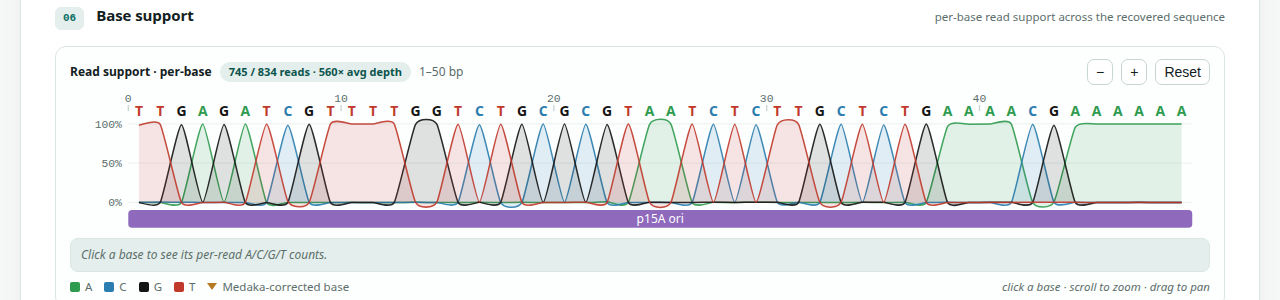
  • The reads behind every base, Sanger-style
  • Annotated map, FASTA and GenBank to download
  • Shareable by link, readable on a phone

The first two are checks EPI2ME's clone-validation report doesn't make.

How we measured: the dataset, both tools' settings and CPU time →

A report you can act on

Every plasmid gets its own report. It opens with the verdict and why, then shows the annotated map, a Sanger-style view of the reads behind every base, and the checks that catch a mixed or contaminated prep, each against its threshold.

No command line, no installation: it runs on our server and opens in any browser.

Open the example report →
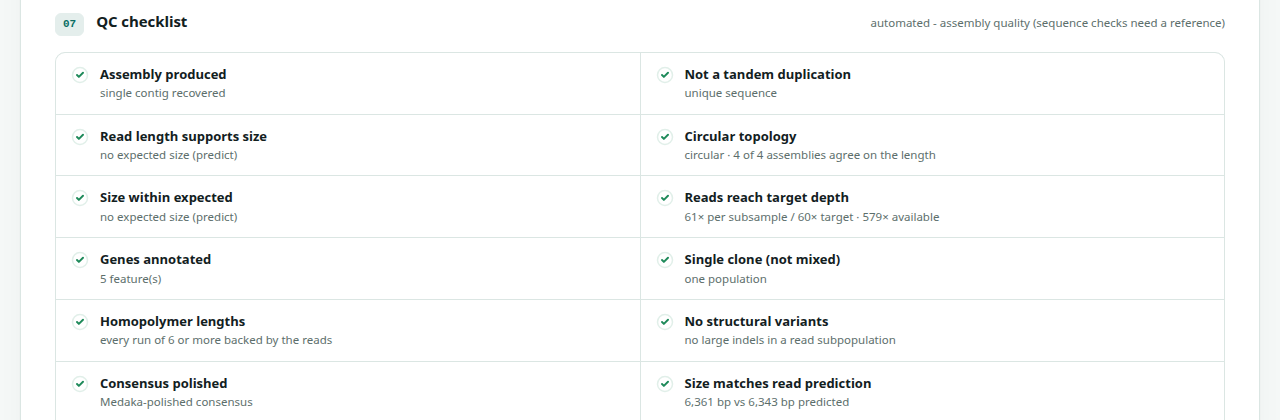
Report header: barcode01, a 6,361 bp circular plasmid, PASS, 15 of 15 QC checks Base-support viewer: the reads behind each base, drawn like a Sanger trace
QC checklist: every check with its value

How it works

1Drop your fastq_pass folder

Drag it onto the upload box, or pick it. Every barcode becomes a sample; a sample sheet is optional.

2PlasValidate does the rest

Size from the reads, assembly, a read-guided consensus, Medaka polishing, annotation and 15 quality checks.

3Open, share and download

Each report opens as soon as it's ready, at its own link. Download the FASTA, GenBank and map.

Try it on your own reads

No account and nothing to install.

Benchmark: Oxford Nanopore's public plasmid_2025.04 dataset (96 designs, each on 4 flow cells: 384 samples, sup basecalls), with EPI2ME wf-clone-validation v1.8.4 in its published configuration on the same workstation; full method. EPI2ME and Oxford Nanopore Technologies are trademarks of Oxford Nanopore Technologies plc; PlasValidate is not affiliated with it.